 Austria
 Belgium
 Bulgaria
 Croatia
 Cyprus
 Czech Republic
 Denmark
 Estonia
 Finland
 France
 Germany
 Greece
 Hungary
 Ireland
 Italy
Italy
 Latvia
 Lithuania
 Luxembourg
 Malta
Malta
 Netherlands
 Northern Ireland
 Polska
 Portugal
 Romania
 Slovakia
 Slovenia
 Spain
Spain
 Sweden
 United Kingdom
 Pусский (RU)
 Yкраїнська (UA)




Fish Collagen or Bovine Collagen? What’s the Difference and What Should You Look For When Choosing?
Fish collagen, marine collagen, bovine collagen, hydrolyzed collagen, collagen peptides… When choosing a collagen supplement, you can quickly come across a whole list of terms that may not mean much at first glance.
One of the most common questions is: is fish collagen or bovine collagen better?
The answer is not as simple as some advertisements might suggest. Both come from animal sources, but they differ primarily in their source, collagen type profile, and the characteristics of the raw material itself.
So, let’s start with the basics.
Fish and marine collagen – are they the same thing?
In supplements, the term "marine collagen” most commonly refers to collagen sourced from fish.
This is the type of raw material used in Marine Glo. According to the label, the source of the collagen is fish, and one daily serving of the product contains 5 g of hydrolyzed fish collagen.
Bovine collagen, on the other hand, comes from cattle. The raw materials used to produce it may include collagen-rich tissues such as skin.
So, the most obvious difference is simple: the source.
Type I, II, III… Collagen has more than one identity
The human body contains many types of collagen, which perform different structural functions.
In the context of supplements, the most commonly discussed types are I, II, and III.
Fish-derived collagen is primarily associated with type I collagen. Bovine collagen is typically associated with types I and III.
However, the type number alone does not automatically tell us which supplement is "better.” When choosing a product, it is also worth considering its form, serving size, and overall formula.

Collagen vs. collagen peptides – what’s the difference?
This is
another term that often appears on product packaging.
Collagen is
a large protein. Supplements often use hydrolyzed collagen. The
hydrolysis process breaks the protein down into smaller fragments known as collagen
peptides.
That is why
the terms "hydrolyzed collagen” and "collagen peptides” are closely related.
Importantly,
both fish and bovine collagen can be hydrolyzed. The word "hydrolyzed” alone
therefore does not tell us the source of the product.
Marine Glo
uses hydrolyzed fish collagen.

Is fish collagen better absorbed?
This is one of the most frequently repeated claims about marine collagen – and it is worth approaching it with caution.
Some publications point to differences in the characteristics of collagen peptides from different sources. However, this does not mean that every fish collagen supplement can simply be advertised as "better absorbed” or "more bioavailable” than every product containing bovine collagen.
The properties of a product are influenced not only by the animal source, but also by the way the raw material is processed, the hydrolysis process, and the characteristics of the resulting peptides.
Therefore, the word "marine” alone should not be treated as a guarantee of superiority over other types of collagen.
And which one has smaller molecules?
This is another area where it is easy to fall into a marketing trap.
You may come across claims that fish collagen "has smaller molecules than bovine collagen.” However, when it comes to supplements containing hydrolyzed collagen peptides, the characteristics of the specific hydrolysate are much more important than the animal source itself.
If a manufacturer provides the average molecular weight of the peptides, specific raw materials can be compared.
If this information is not available, we should not assume that every fish collagen product will contain smaller peptides than every bovine collagen product.
Is one of them more “beauty-focused”?
Fish collagen is very commonly found in beauty supplements. However, this does not mean that its marine origin alone provides a basis for making cosmetic or beauty-related claims.
For food supplements, what matters are the ingredients for which appropriate authorized health claims can be used.
A good example is vitamin C, which contributes to normal collagen formation for the normal function of skin.
Marine Glo provides 25 mg of vitamin C per sachet, equivalent to 31% of the RI.
The formula also contains niacin and biotin, which contribute to the maintenance of normal skin. One sachet provides 16 mg of niacin (100% RI) and 300 µg of biotin (600% RI).
This information is much more specific than simply describing a product as a "beauty collagen.”

Fish or bovine – what about diet and allergies?
The source of collagen can also matter for very practical reasons.
Fish collagen comes from fish, so it is not suitable for people with a fish allergy. Bovine collagen, on the other hand, comes from cattle.
Neither is suitable for vegans or vegetarians.
This is also worth remembering when you come across the term "plant-based collagen.” Plants are not a source of collagen. Products described this way may contain ingredients that have specific functions related, for example, to normal collagen formation, but they are not plant-derived collagen.
Fish Collagen vs. Bovine Collagen – Key Differences
Fish Collagen vs. Bovine Collagen – Key Differences
| Feature | Fish Collagen | Bovine Collagen |
|---|---|---|
| Source | Fish | Cattle |
| Other name | Often "marine collagen” | "Bovine collagen” |
| Predominant types | Mainly type I | Mainly types I and III |
| Can be hydrolyzed | Yes | Yes |
| Can occur as peptides | Yes | Yes |
| Suitable for vegans | No | No |
| Fish allergy | Should be avoided | Not related to the collagen source |
| Does the source alone determine which is "better”? | No | No |
What matters more than the words “marine” or “bovine”?
If you are standing in front of a shelf with several products, it is worth checking four things in particular.
First – the source of the collagen. It should be clearly stated.
Second – the form. Check whether the manufacturer uses hydrolyzed collagen or collagen peptides.
Third – the amount in the daily serving. A large package does not necessarily mean a large daily serving of collagen.
And finally – the complete formula. Look at what additional ingredients the product contains and in what quantities.
So, where does Marine Glo fit in?
Marine Glo belongs to the category of products using fish-derived collagen. One sachet, which constitutes the daily serving, provides 5 g of hydrolyzed fish collagen.
The formula is complemented by vitamin C, niacin, biotin, and FloraGLO® lutein. Vitamin C contributes to normal collagen formation for the normal function of skin and contributes to the protection of cells from oxidative stress. Biotin and niacin contribute to the maintenance of normal skin.
The product has a tropical flavor, contains no sugar or gluten, and, according to the label, contains no artificial flavors or colors. One sachet should be mixed with 355–473 ml of water and taken once daily.
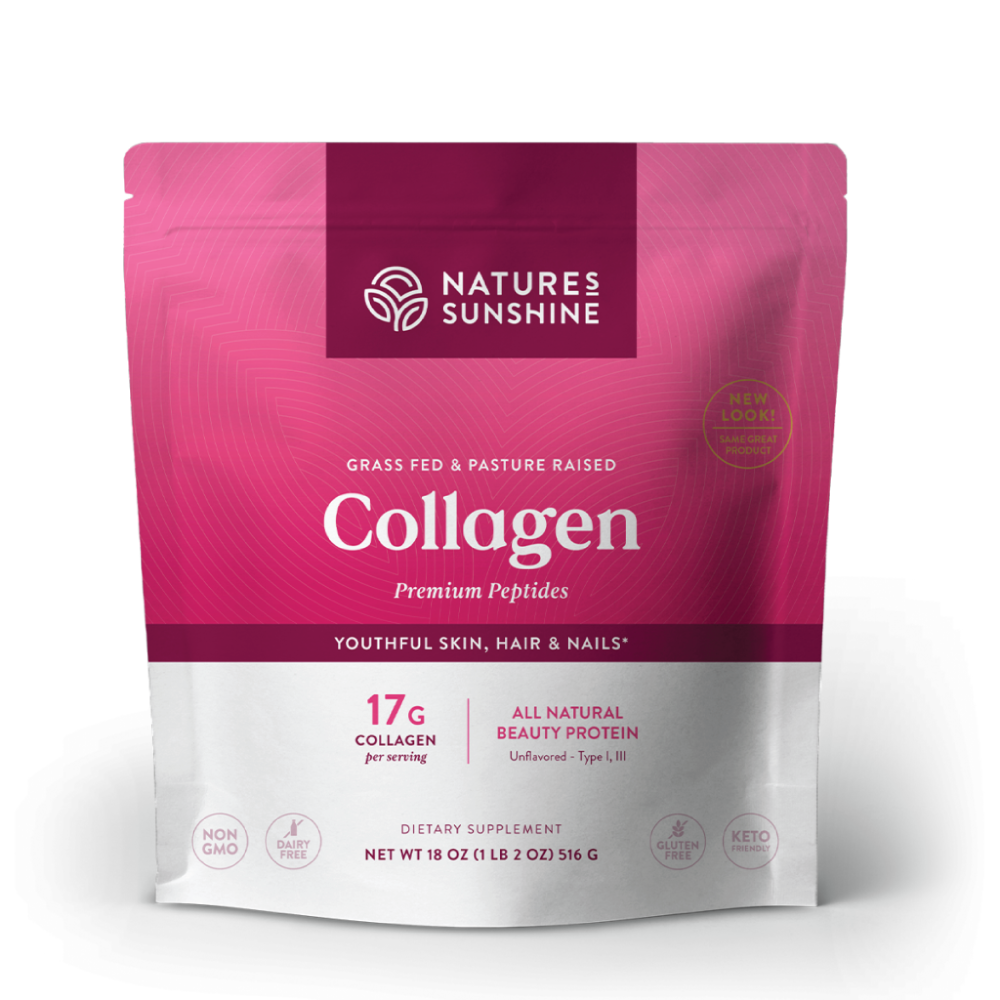
So: fish collagen or bovine collagen?
There is no need to create a simple ranking in which one always wins.
Fish and bovine collagen differ primarily in their source and the characteristics of the raw material. Both can be used in hydrolyzed form.
Instead of focusing on the claim of having the "best collagen,” it is better to learn how to read the label and compare specific products: source → form → amount per daily serving → other ingredients.
This tells you much more about a product than the word "marine” on the packaging alone.
Food supplement. Contains a sweetener. Do not exceed the recommended daily serving. Food supplements should not be used as a substitute for a varied diet. A balanced diet and a healthy lifestyle are the basis for the proper functioning of the body.