 Austria
 Belgium
 Bulgaria
 Croatia
 Cyprus
 Czech Republic
 Denmark
 Estonia
 Finland
 France
 Germany
 Greece
 Hungary
 Ireland
 Italy
Italy
 Latvia
 Lithuania
 Luxembourg
 Malta
Malta
 Netherlands
 Northern Ireland
 Polska
 Portugal
 Romania
 Slovakia
 Slovenia
 Spain
Spain
 Sweden
 United Kingdom
 Pусский (RU)
 Yкраїнська (UA)




What Exactly Are Probiotics?
Probiotics are live microorganisms that, when administered in adequate amounts, may provide a health benefit to the host. Among the best-known are selected bacteria from the genera Lactobacillus and Bifidobacterium, although the world of microorganisms used in foods and food supplements is much more diverse.
Importantly, not all probiotics are the same.
When it comes to microorganisms, the specific strain is of particular importance. Two microorganisms belonging to the same species may have different properties. Therefore, the results of studies conducted on one strain should not automatically be attributed to all bacteria belonging to the same species.
This is one of the fundamental principles of modern probiotic science.

The Microbiota – A Remarkable Ecosystem
The human gastrointestinal tract is home to an enormous number of microorganisms that form a complex ecosystem known as the gut microbiota.
Its composition is not fixed. It changes with age, diet, the environment and many other factors.
In children, the development of the microbiota is particularly dynamic. Factors influencing its development include feeding practices, dietary diversity, the environment and the use of medications.
There is no single "ideal” microbiota composition that should be identical in every child. Each individual has their own unique microbial ecosystem.
Why Does the Strain Matter?
Let’s imagine that we want to evaluate the effects of a specific bacterial strain. Researchers conduct a study involving a particular group of people, use a specific dose and observe selected parameters over a defined period of time.
If the study produces interesting results, these results primarily relate to the strain used and the specific conditions of the study.
This does not automatically mean that the same effect will be observed with every other probiotic.
For this reason, a high-quality probiotic product should provide clear and precise information about the microorganisms it contains.
Probiotics in a Child’s Diet
A child’s diet should always be based on a well-balanced eating pattern appropriate for their age.
A varied daily diet should provide a range of nutrients. Depending on the child’s age and individual needs, this may include vegetables, fruit, grains, sources of protein, as well as dairy products or suitable alternatives.
Probiotic foods and food supplements do not replace a balanced diet. They may, however, form part of a conscious approach to everyday nutrition.
What Should You Consider When Choosing a Probiotic for a Child?
It is not advisable to focus solely on the large number of bacteria stated on the packaging.
1. Check the Strain
Information about the genus and species of a microorganism is a good starting point, but the ability to identify the specific strain is particularly valuable.
2. Consider the Amount of Microorganisms
The number of live microorganisms is often expressed in CFU – colony-forming units.
A higher number of CFUs does not automatically mean a better product. What matters is the appropriate combination of strain, dose and intended use of the product.
3. Check the Storage Conditions
Live microorganisms can be sensitive to temperature, humidity and other environmental conditions. It is therefore important to follow the storage instructions provided by the manufacturer.
4. Consider the Child’s Age
The product should be intended for the appropriate age group, and its recommended use should be clearly specified.
5. Look for Transparent Information
For products containing microorganisms, information about their identification, quantity, storage conditions and recommended use is particularly important.

Probiotics and Antibiotics
Antibiotic therapy is an important part of treating bacterial infections. At the same time, researchers are studying how antibiotics affect the gut microbiota.
Certain specific microbial strains have been investigated in studies involving their use during antibiotic therapy. However, the results of such studies cannot automatically be applied to all probiotics.
If a child is taking antibiotics, the choice of a specific product should be discussed with a doctor or pharmacist, particularly in the case of young children or children with additional health conditions.

A Probiotic Is More Than Just a “Bacteria Count”
Communication about probiotics often focuses primarily on the number of CFUs. However, the number of microorganisms alone does not tell us everything about the quality of a product.
A whole range of factors is important:
strain → quantity → stability → storage conditions → intended use → available scientific evidence.
This approach allows us to take a more informed view of probiotics.
Science First
At Nature’s Sunshine, we believe that informed supplementation starts with knowledge.
It is therefore important to distinguish between information arising from scientific research and claims that may legally be used in communication concerning foods and food supplements.
In the European Union, the use of health claims is regulated by law. Not every statement describing a potential effect of a microorganism may be used on a label, website or in promotional materials.
This also applies to commonly used statements linking probiotics with immunity, gut health or microbiota balance. The fact that a particular topic is being studied scientifically does not, in itself, mean that a specific statement constitutes an authorised health claim in the EU.
This is an important distinction between probiotic science and marketing communication about a product.
Everyday Care Starts with the Basics
A child’s health does not depend on a single ingredient or a single product.
The foundations are everyday habits: a varied diet, adequate sleep, physical activity, hydration and a thoughtful approach to supplementation.
Probiotics are an interesting and rapidly developing area of scientific research. However, when choosing a product for a child, it is worth looking beyond attractive claims on the packaging and focusing primarily on the specific microorganism, its strain, quantity, intended use and the quality of the available evidence.
Because in the world of microorganisms, details matter.
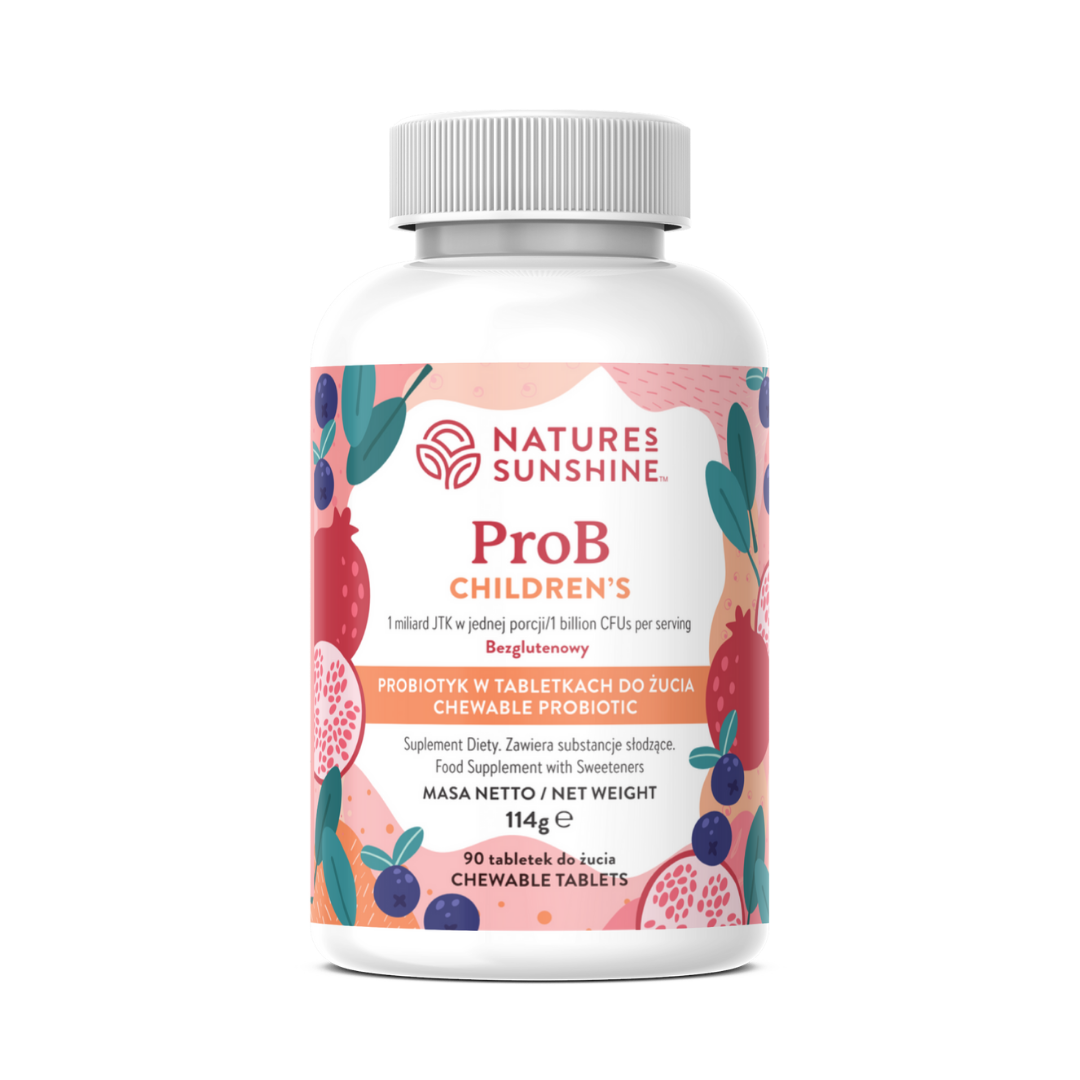
Nature’s Sunshine – Knowledge, Quality and Informed Choices
Informed supplementation starts with good information. That is why it is worth learning about product ingredients, understanding the role of individual components and choosing solutions suited to individual needs.
When considering supplementation for children, the choice should always take into account the child’s age, dietary pattern and individual circumstances. If in doubt, consult a doctor or pharmacist.